In the rapidly evolving landscape of modern hip-hop, few artists have captured the underground zeitgeist quite like Destroy Lonely. Emerging from the highly competitive Atlanta rap scene, this genre-defying artist has successfully carved out a unique sonic lane that blends atmospheric trap beats with introspective, raw lyricism. While many fans are constantly searching for details about the Destroy Lonely age, his rapid ascent to stardom—culminating in a highly coveted record deal with Playboi Carti’s Opium label—proves that his musical maturity far exceeds his years.
Today’s digital music consumers are looking for more than just catchy hooks; they demand authenticity, intricate production, and a deep understanding of the artist’s personal background. Destroy Lonely, whose real name is Bobby Wardel Sandimanie III, represents the vanguard of a new generation of rappers. He grew up surrounded by the music industry, teaching himself audio production in isolation, which ultimately birthed his enigmatic stage name. This comprehensive guide will deeply explore the Destroy Lonely age, his family roots, his breakthrough tracks like “Bane” and “Oh Yeah,” and the profound impact he is currently making on global hip-hop culture.
Understanding an artist’s trajectory requires looking beyond basic streaming numbers. It involves analyzing their creative influences, their strategic collaborations, and the cultural environment that shaped them. For Destroy Lonely, the vibrant, historically rich musical ecosystem of Atlanta, Georgia, served as the ultimate incubator. By the time he was a teenager, he was already navigating the complex realities of music production. Let’s delve into the factual biography, early life, and career milestones of the artist who is redefining the modern rap aesthetic.
How Old is Destroy Lonely? Understanding the Destroy Lonely Age and Early Life
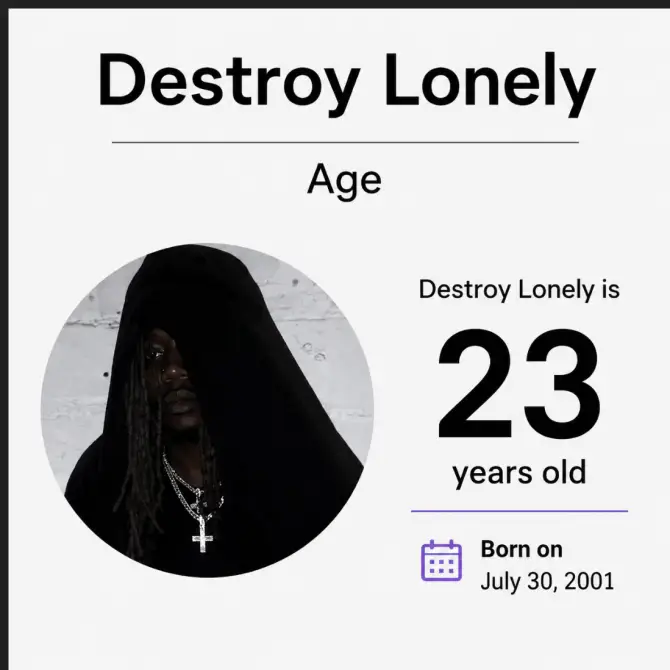
One of the most frequently asked questions across search engines and social media platforms is regarding the Destroy Lonely age. Born on July 30, 2001, in Atlanta, Georgia, Destroy Lonely is currently 24 years old (as of 2026). As a Leo, his astrological sign is often associated with creativity, natural charisma, and a commanding stage presence—traits that are undeniably evident in his highly energetic live performances and distinct aesthetic.
Being born in 2001 places Destroy Lonely squarely in Generation Z, a demographic that consumes and creates music with an unprecedented level of digital fluency. His age is significant because it contextualizes his rapid rise in the industry. By his early twenties, he had already achieved milestones that take many artists a lifetime to reach. Growing up in the early 2000s meant he was exposed to the golden era of Atlanta trap music during his formative years, while simultaneously having access to the borderless, internet-driven SoundCloud rap era as a teenager.
His early life was deeply entrenched in musical culture. Rather than relying solely on studio engineers, a significant portion of his youth was spent in solitude, meticulously teaching himself the highly technical art of audio engineering and beat production. This period of intense, solitary creative development directly inspired his stage name, “Destroy Lonely.” It reflects a period of isolation that was ultimately destroyed by his burgeoning passion and eventual massive success in music.
The Family Legacy: Bobby Wardel Sandimanie III and Rapper I-20
To fully understand the artistic depth of Destroy Lonely, one must look at his family lineage. Born Bobby Wardel Sandimanie III, he did not enter the music industry as a complete outsider. His father is the established Atlanta rapper known as I-20 (Bobby Sandimanie). I-20 is a notable figure in Southern hip-hop, famous for his deep, resonant vocal delivery and his close affiliation with Ludacris and the Disturbing tha Peace (DTP) record label.
Growing up with a father who had successfully navigated the mainstream rap industry in the early 2000s provided Destroy Lonely with invaluable, behind-the-scenes insights into the realities of the music business. While some artists hide their familial connections, the relationship between I-20 and Destroy Lonely highlights a fascinating generational bridge in Atlanta hip-hop. I-20 represents the classic, bar-heavy era of Southern rap, while his son represents the melodic, fashion-forward, atmospheric wave of the modern Opium era.
Despite this legacy, Destroy Lonely consciously chose to build his brand independently. He did not leverage his father’s industry connections for a shortcut to fame. Instead, he started from the ground up, collaborating with high school peers and releasing underground tracks, ensuring that his success was a direct result of his own unique sound and relentless work ethic.
Early Musical Beginnings and the Atlanta Hip-Hop Scene
Atlanta, Georgia, is widely considered the modern epicenter of global hip-hop. The city’s fiercely competitive environment demands originality. Before attaining international fame, Destroy Lonely was a high school student quietly developing his craft. He began his recording journey by collaborating heavily with fellow underground rapper Nezzus.
Together, they navigated the local SoundCloud scene, experimenting with different vocal inflections, distorted 808s, and ambient synth layers. This era of his career was crucial. It allowed him to find his specific vocal tone—a mesmerizing blend of high-pitched melodies and rhythmic, rapid-fire flows. He officially debuted in 2018 with the underground single “Bag Full of Boof.” While it didn’t immediately break the Billboard charts, the track was highly praised within niche internet music communities and established him as a serious prospect in the Atlanta underground.
The Breakthrough: “Bane” and Viral Streaming Success
The pivotal turning point in Destroy Lonely’s early career occurred in 2019 with the release of the single “Bane.” The track showcased a massive leap in production quality and vocal confidence. “Bane” quickly gained extreme traction on platforms like TikTok and SoundCloud, eventually migrating to mainstream DSPs (Digital Service Providers) where it racked up millions of streams on Spotify and Apple Music.
The success of “Bane” proved that Destroy Lonely’s appeal was not localized to Atlanta; his atmospheric, emotionally resonant sound had global commercial viability. The song’s viral nature demonstrated his innate understanding of modern digital marketing and the listening habits of his core Generation Z demographic.
Catching the Attention of Playboi Carti: The Opium Label Signing
In the modern rap industry, co-signs from established megastars can alter an artist’s trajectory overnight. For Destroy Lonely, this moment arrived via the track “Oh Yeah.” The song’s unique cadence and dark, avant-garde production caught the attention of none other than Playboi Carti, one of the most influential and stylistically innovative rappers of his generation.
Playboi Carti was in the process of building his own record label, Opium, an imprint under Interscope Records. Carti was actively seeking artists who shared his vision for pushing the boundaries of hip-hop, fashion, and visual aesthetics. Destroy Lonely’s sound—often described as a darker, more lyrical evolution of Carti’s own “rage” and “vamp” aesthetics—was a perfect fit.
The official signing to Opium skyrocketed Destroy Lonely from an underground sensation to a mainstream highly anticipated act. Being part of the Opium roster (alongside artists like Ken Carson and Homixide Gang) provided him with elite industry resources, high-budget music videos, and access to world-class producers, all while allowing him to maintain absolute creative control over his dark, highly stylized brand.
Musical Inspirations and the Influence of Tyler, The Creator
While his immediate sonic comparisons are often drawn to his mentor Playboi Carti, Destroy Lonely has publicly cited a diverse range of musical inspirations. Chief among them is Tyler, The Creator. Tyler’s influence is evident not necessarily in Destroy Lonely’s vocal delivery, but in his approach to world-building and artistic independence.
Tyler, The Creator famously taught himself production, directed his own videos, and created a distinct, uncompromising visual universe with Odd Future. Similarly, Destroy Lonely’s background in teaching himself audio production and his heavy emphasis on high-fashion, gothic, and avant-garde aesthetics mirror Tyler’s multi-disciplinary approach. This deep respect for artistry over mere “clout” is a significant reason why critics and hardcore fans respect Destroy Lonely’s creative output.
Social Media Presence and the Cult of Personality
In today’s industry, an artist’s digital footprint is nearly as important as their discography. Destroy Lonely has cultivated a massive, highly engaged following. His official Instagram account, where he frequently posts high-fashion editorial shots, behind-the-scenes studio sessions, and cryptic visual art, has amassed over 1.7 million followers.
He utilizes social media not just for promotion, but as an extension of his artistic persona. By maintaining an aura of mystery—rarely doing traditional media interviews and communicating primarily through highly curated visual aesthetics—he has generated a cult-like fanbase. This strategy of scarcity and mystique forces fans to obsess over every snippet of music and every stylistic choice, driving intense organic engagement whenever he drops a new project.
Key Takeaways: Why Destroy Lonely is the Future of Rap
- Age and Trajectory: Born July 30, 2001, the 24-year-old artist has achieved mainstream dominance at a remarkably young age.
- Industry Lineage: As the son of Atlanta rap veteran I-20, he possesses a deep, generational understanding of the music business.
- Self-Taught Talent: His stage name honors his solitary teenage years spent mastering audio production software.
- The Opium Co-Sign: Catching the ear of Playboi Carti with “Oh Yeah” led to his pivotal signing with the highly influential Opium label.
- Cultural Impact: With millions of streams on hits like “Bane” and a massive Instagram following, he is a primary architect of the modern underground-to-mainstream rap pipeline.
Frequently Asked Questions (FAQs)
What is the Destroy Lonely age?
Destroy Lonely was born on July 30, 2001. As of 2026, he is 24 years old.
What is Destroy Lonely’s real name?
His real legal name is Bobby Wardel Sandimanie III.
Who is Destroy Lonely’s father?
His father is the well-known Atlanta rapper I-20, who rose to fame collaborating with Ludacris and the Disturbing tha Peace label in the early 2000s.
What record label is Destroy Lonely signed to?
He is currently signed to Opium, a record label founded by Playboi Carti, which operates under Interscope Records.
What was Destroy Lonely’s debut song?
He officially debuted in 2018 with the underground single titled “Bag Full of Boof,” though songs like “Bane” and “Oh Yeah” truly catapulted him to mainstream fame.
Conclusion: The Continued Evolution of Destroy Lonely
The fixation on the Destroy Lonely age is a testament to how much he has accomplished in such a brief period. At just 24 years old, Bobby Wardel Sandimanie III has transitioned from a self-taught, isolated teenager in Atlanta to a global superstar backed by Playboi Carti’s Opium label. His ability to blend the gritty reality of Atlanta hip-hop with high-fashion, avant-garde aesthetics has cemented his position as a pioneer for Generation Z music consumers.
As he continues to release critically acclaimed projects, amass millions of streams, and expand his 1.7 million-strong Instagram cult following, it is clear that his influence will only grow. Destroy Lonely is not just participating in the current wave of rap; he is actively dictating its future direction.